

How Desensitization Is Like Learning How To Swim

Dogs learn about the world they live in through their experiences (both good and bad) and, since life always has some sort of new experience in store, it’s important to help your dog be in a position to have a positive learning experience with whatever you're introducing her to.
While this is true for all dogs, it’s especially true for dogs that tend to be worried or cautious when experiencing new things, as well as for dogs that have had a less-than-stellar experience with something and are going to be introduced to it again.
Providing A Greater Chance Of Success
When I talk to clients about “...putting your dog in a position to have a positive experience...” it’s easy enough for them to grasp the concept, but it’s important for them to fully grasp the mechanics of putting that concept into practice. So that’s why I will often ask them: “When learning how to swim, what’s going to provide you with the greater chance of success... getting started in the shallow end of the pool or jumping straight in the deep end?”
Starting In ‘The Shallow End’
As you would expect, most people choose the “shallow end of the pool” answer because they know the ‘shallow end’ feels safer, which will allow them to relax so they can concentrate on building up their abilities and confidence until they are ready to....... do what? Climb out of the pool and immediately proceed to the deep end, and (with fingers crossed) jump in. Considering that we’re looking for a strategy that will provide a greater chance of success, then no, experimenting with the deep end of the pool so quickly would be too risky for most people.
Instead, a more successful strategy would be for them to build up their abilities and confidence in the ‘shallow end’ until they are ready to move closer to the ‘deep end’. How much closer? It all depends on what they are comfortable with... even as little as a single step closer if that's all they can cope with at that point in time. And after taking that next step they will begin the process of building up their abilities and confidence at that new depth until they feel ready to increase the difficulty factor again.
Through the use of this step-by-step approach, they will make their way toward the deep end of the pool and, before they know it, they have the skills and confidence to swim around at that depth.
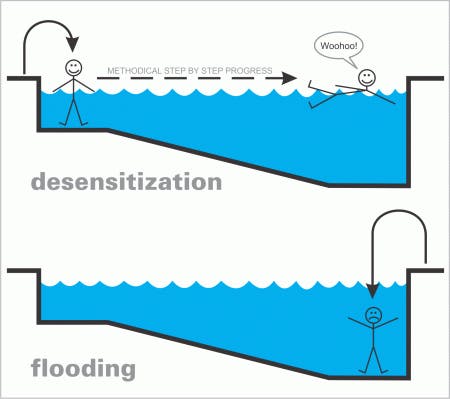
Starting Your Dog In ‘The Shallow End’
As you’ve probably already surmised, all of this talk about ‘learning how to swim’ is analogous to the process of habituating your dog to a new environment, situation, person, noise, dog, object, (etc.) through a process of desensitization.
- Whether your dog is sensitive to novel experiences or novel objects, the method that's going to provide you with the greater chance of successfully introducing (or re-introducing) her to the stimulus is to start with a small amount (ie: 'the shallow end of the pool') so she is able to cope adequately.
- For a dog that is worried/fearful of other dogs: Introducing the dog to the stimulus in a ‘small amount’ means starting from a distance that’s far enough away so that she isn't reactive to it. For that worried/fearful dog, greater distance from the stimulus means greater safety and a greater ability for her to learn to cope.
- For a dog that is being introduced to a new object such as a muzzle: Introducing the dog to it in a ‘small amount’ might mean initially leaving the muzzle lying around the house so she can look at it and sniff it, and determine that it’s no more interesting or worrisome than the TV remote control. Better yet, try pairing the presence of the muzzle with a good experience such as praise and a treat, so your dog learns that 'good things' happen when this strange new thing is present.
How Small is Small Enough?
How do you know if the ‘small amount’ of stimulus you are exposing your dog to is small enough? You don’t have to guess... just look at your dog and she will tell you how she’s feeling through the display of her body language and behavior.
- If you get the level of exposure right, your dog should look interested or curious but still relatively relaxed, and she should be able to respond to your cues and even be distracted by other stimuli. When your dog shows that she is successfully coping with the presence of the stimulus in this manner, you should then be able to raise the difficulty factor by moving closer to the stimulus or increasing the amount of exposure to the object.
- How much do you increase the exposure? Again, let your dog tell you. If she’s not coping well, then you’re asking for too much too soon, so you will need to take a step back towards that figurative ‘shallow end of the pool’ and spend more time at that level. Just like in the ‘learning to swim’ comparison, each time you raise the difficulty factor you need to give your dog the time necessary to habituate to that new level. You can definitely aid the desensitization process by interacting with your dog and positively reinforcing all desirable behaviors in the presence of the stimulus/object until she shows you that she’s coping well and capable of having the exposure increased.

Desensitization versus Flooding
‘Flooding’ is the opposite of desensitization... so if I can go back to my ‘learning how to swim’ analogy one last time, this would be the equivalent of getting started by jumping straight into the deep end of the pool.
With flooding, the dog would be exposed to the full force of the stimulus with the hope that she will habituate to it. Please know that this method is not recommended because it’s possible for flooding to ‘sensitize’ the dog to the stimulus (rather than desensitize) thus making her fearful (or perhaps even more fearful) of the stimulus.
No Lack Of Examples
There is no lack of examples where introductions and re-introductions through desensitization may be beneficial or an absolute necessity.
Some common ones include Unknown people (adults and children), traffic noise, muzzles, crates, handling of paws, nail trimming, unknown dogs, bicycles, skateboards, scooters, slippery floor surfaces, confined spaces, the sound of power tools and gas-powered tools... and many more.